On 16 October, 1882, the aspiring young trainee painter Blanche visited Edouard Manet (French, Paris 1832–1883 Paris) in his new studio at 77 rue d’ Amsterdam in Paris.
He was tasked with the “test ultime pour le peintre” (ultimate test for a painter), to paint an ordinary bun.
“Bring me a brioche, I want to see you paint a brioche, if you can paint a brioche then you can call yourself a painter.”,
said the Master to the trainee.
The first painting is by Chardin, who influenced Manet.
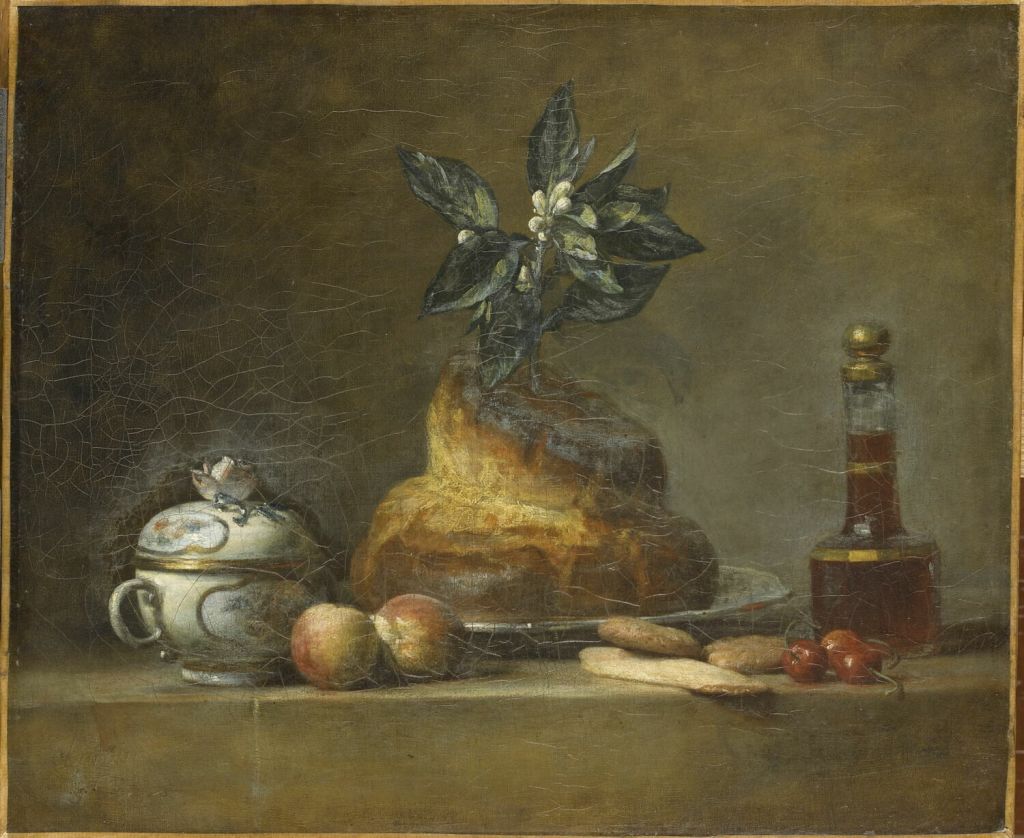
Brioche, 1763, Chardin, Jean Baptiste Siméon, Oil on canvas
Dimensions: Height: 0.47 m; Height with frame: 0.58 m; Width: 0.56 m; Width with frame: 0.675 m
Musée du Louvre, Paris
Three Manet paintings follow.
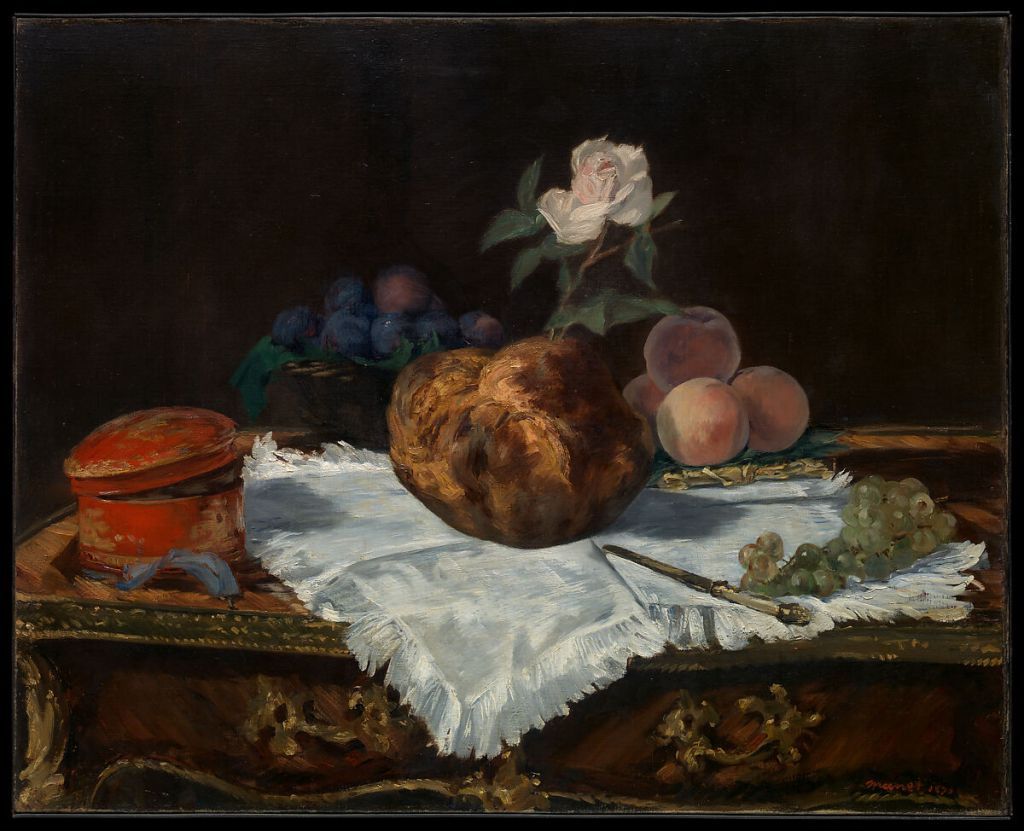
The Brioche, Edouard Manet, 1870, Oil on canvas
Dimensions: 25 5/8 x 31 7/8 in. (65.1 x 81 cm)
Metropolitan Museum of Art, New York
This painting is in the public domain
‘Manet reportedly called still life the “touchstone of the painter.” From 1862 to 1870 he executed several large-scale tabletop scenes of fish and fruit, of which this is the last and most elaborate. It was inspired by the donation to the Louvre of a painting of a brioche by Jean Siméon Chardin, the eighteenth-century French master of still life. Like Chardin, Manet surrounded the buttery bread with things to stimulate the senses—a brilliant white napkin, soft peaches, glistening plums, a polished knife, a bright red box—and, in traditional fashion, topped the brioche with a fragrant flower.’
The background is dark. in contrast with the white napkin, which only partially covers the surface of the elaborate table. There are peaches, as in Chardin’s picture, grapes (in the Chardin picture there are cherries), a white – pink rose (in the Chardin picture I see a lemon tree twig), and a luxurious red box (in the Chardin picture I see a fine porcelain sugar bowl).
In 1872 Manet painted a picture with brioche, oysters and lemon.

Nature morte, brioche, fleurs, poires (Brioche with Pears), Edouard Manet, 1876, Oil on canvas
Dimensions height: 46 cm (18.1 in); width: 54 cm (21.2 in)
Dallas Museum of Art
The darkness of the 1870 Manet picture is gone. This painting is bright, joyous and the painter’s brush is care free. The white – pink rose is now in the centre of the composition (it was slightly on the upper right side of the 1870 picture). The peaches of the earlier picture have given their place to pears, there are no grapes, the table cloth covers the surface of the table, and the knife is on the left side, its lower part sitting off the table’s edge.
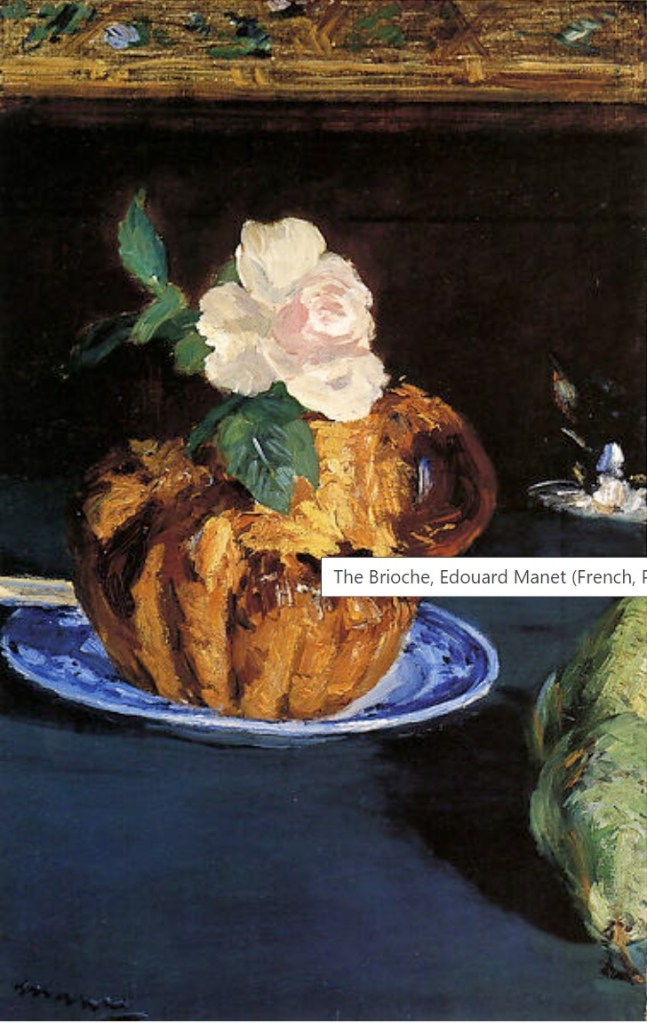
Edouard Manet, “Still Life with Brioche,” 1880, oil on canvas,
Dimensions: 21 3/4 x 13 7/8 in. (55.25 x 35.24 cm)
Carnegie Museum of Art, Pittsburgh
The 1880 painting is dark compared to the 1876 picture.
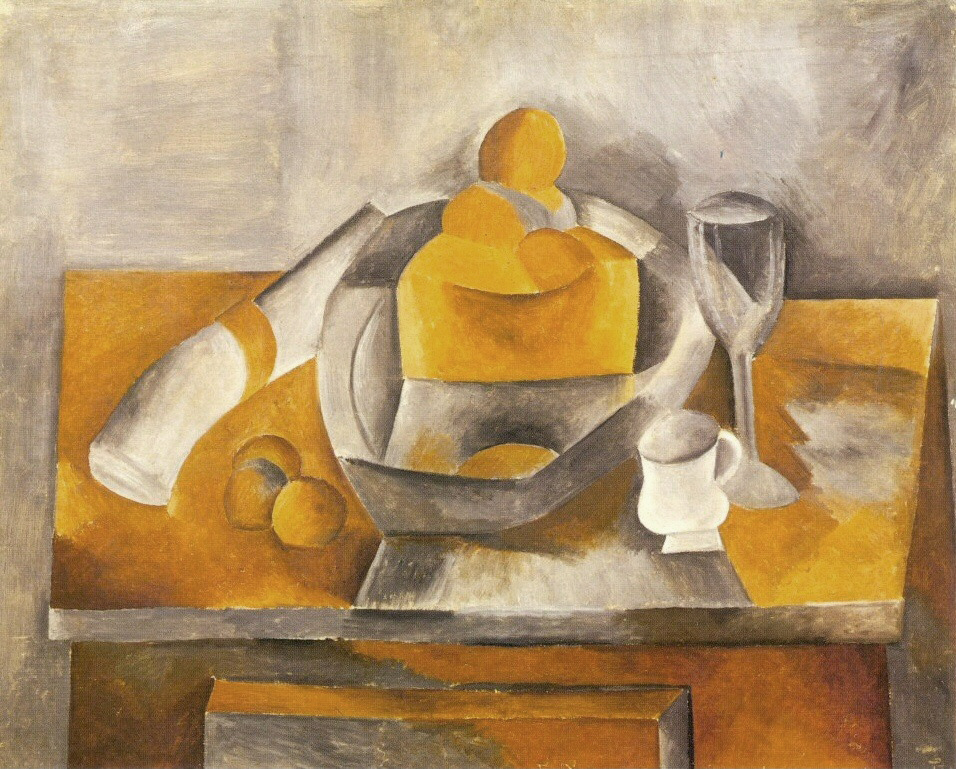
Pablo Picasso, 1909, La Brioche (Nature morte à la brioche).
This painting by Pablo Picasso is in the public domain in the United States because it was first published before 1923.
The palette of the artist is extremely limited. The napkin if folded, the table is small, there are some fruits, a glass and a small cup.
 Gastrolvios