‘In December 1883 Vincent van Gogh went to live with his parents in the Dutch town of Nuenen where his father was the pastor at the Dutch Reformed church. Having spent three and a half years struggling to forge a viable career for himself as an artist, Van Gogh arrived home hungry, impoverished and emotionally spent. His immense efforts had so far yielded nothing of substance, and the retreat to Nuenen was intended to give him time to repair his health, improve his finances and calmly pursue his art. When he left Nuenen two years later in November 1885, he had amassed a large body of work, including The Potato Eaters, his first masterpiece, but his time there had been fraught with incident.’ (Wordstable, Paul Williamson)
In February 1885 while Van Gogh was in Nuenen, near Eindhoven, in the Netherlands, he painted ‘The Potato Peeler’, which today is in the collection of the Metropolitan Museum of New York.
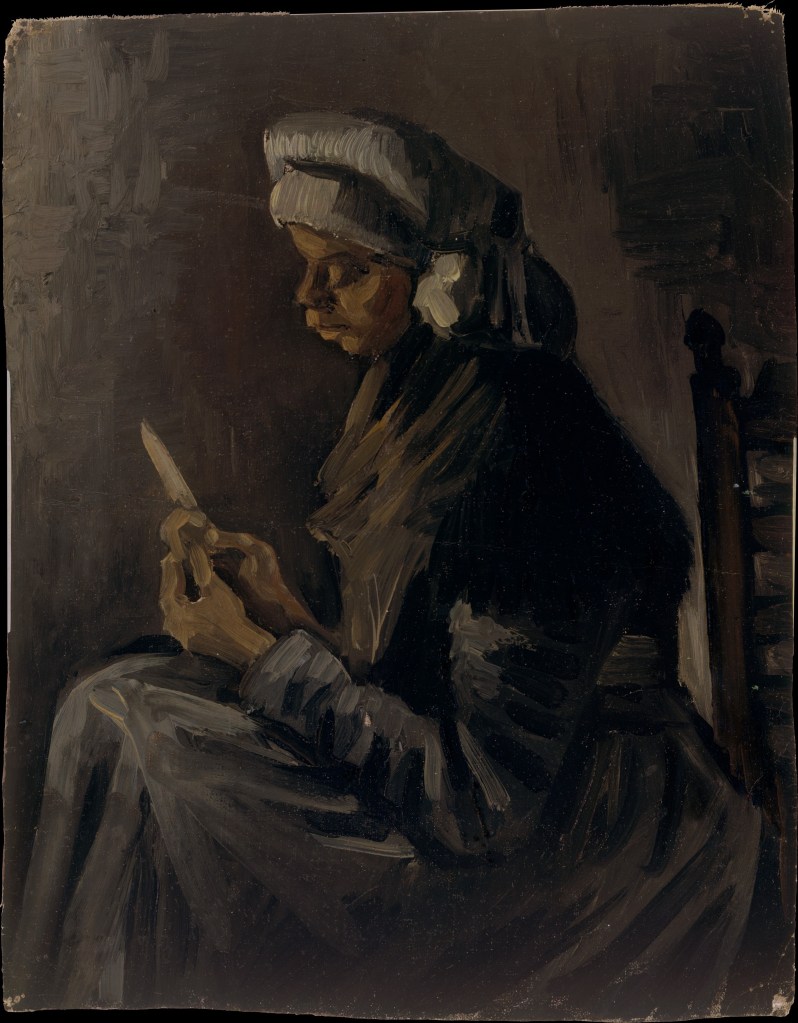
The Potato Peeler, Vincent van Gogh, 1885, Oil on canvas. On the reverse side, in 1887 van Gogh painted ‘Self-Portrait with a Straw Hat’.
Dimensions: 16 x 12 1/2 in. (40.6 x 31.8 cm)
Metropolitan Museum of Art, New York
This painting from February/March 1885, with its restricted palette of dark tones, coarse facture, and blocky drawing, is typical of the works Van Gogh painted in Nuenen the year before he left Holland for France. His peasant studies of 1885 culminated in his first important painting, The Potato Eaters (Van Gogh Museum, Amsterdam).
In April 1885 van Gogh painted a study for ‘The Potato Eaters’, and sent to his brother Theo van Gogh in Paris on the 5th May 1885.
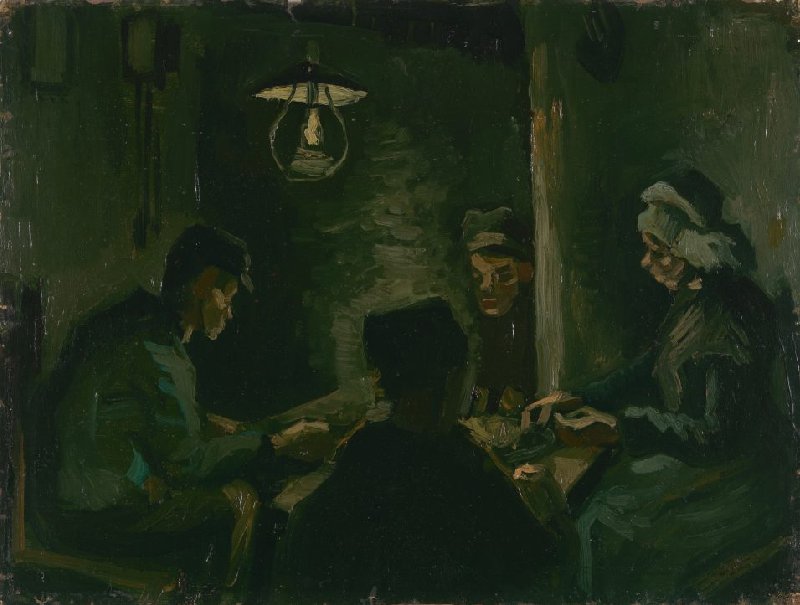
Study for ‘The Potato Eaters’
Vincent van Gogh (1853 – 1890), Nuenen, April 1885
oil on canvas, 33.6 cm x 44.5 cm
Credits: Van Gogh Museum, Amsterdam (Vincent van Gogh Foundation)
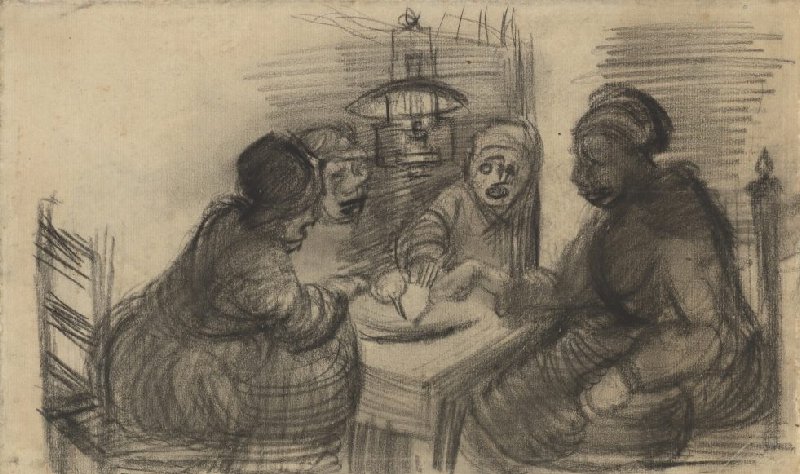
Four People Sharing a Meal
Vincent van Gogh (1853 – 1890), Nuenen, March – April 1885
chalk on paper, 20.9 cm x 34.6 cm
Credits: Van Gogh Museum, Amsterdam (Vincent van Gogh Foundation)
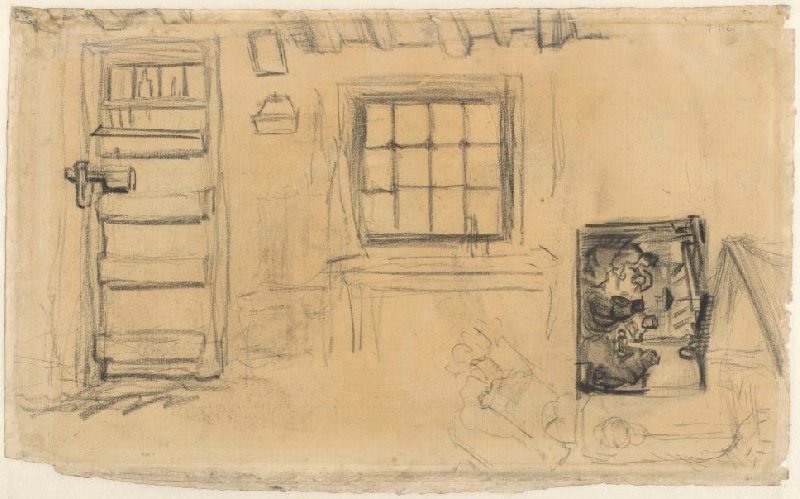
Vincent van Gogh, 1885
Studies of the Interior of a Cottage, and a Sketch of ‘The Potato Eaters’
Vincent van Gogh (1853 – 1890), Nuenen, March-April 1885
chalk on paper, 21.3 cm x 34.6 cm
Credits: Van Gogh Museum, Amsterdam (Vincent van Gogh Foundation)
In May 1885 the painter completed ‘The Potato Eaters’, which he had started in April of the same year.
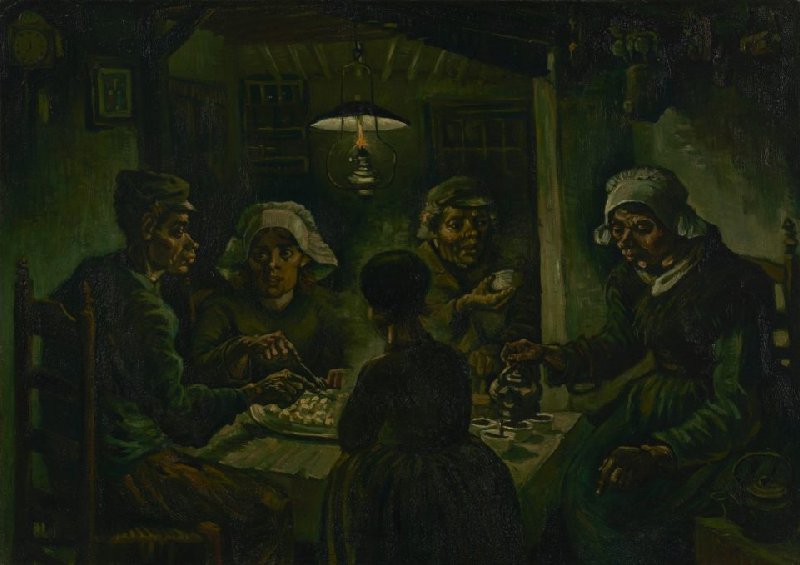
The Potato Eaters, Vincent van Gogh, April-May 1885
oil on canvas, 82 cm x 114 cm
Credits: Van Gogh Museum, Amsterdam (Vincent van Gogh Foundation)
‘Van Gogh saw the Potato Eaters as a showpiece, for which he deliberately chose a difficult composition to prove he was on his way to becoming a good figure painter. The painting had to depict the harsh reality of country life, so he gave the peasants coarse faces and bony, working hands. He wanted to show in this way that they ‘have tilled the earth themselves with these hands they are putting in the dish … that they have thus honestly earned their food’.
He painted the five figures in earth colours – ‘something like the colour of a really dusty potato, unpeeled of course’. The message of the painting was more important to Van Gogh than correct anatomy or technical perfection. He was very pleased with the result: yet his painting drew considerable criticism because its colours were so dark and the figures full of mistakes. Nowadays, the Potato Eaters is one of Van Gogh’s most famous works.‘
The clock shows the time of the dinner to be 7 pm. The potatoes are still steaming. There is not a note of romanticism in the picture, nor the refined approach to portraiture of the period. The harshness of the peasants’ life is expressed by the earthy dark colours that take us back to van Gogh’s beloved painter, Rembrandt.
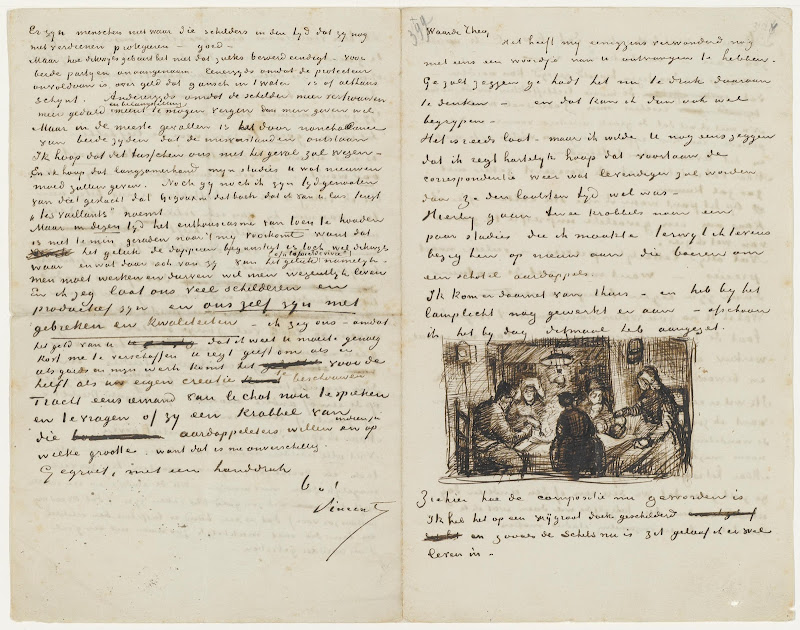
Letter from Vincent van Gogh to Theo van Gogh with sketch of The Potato Eaters (recto)
Vincent van Gogh (1853 – 1890), Nuenen, 9 April 1885
pen and ink on paper, 20.7 cm x 26.4 cm
Credits: Van Gogh Museum, Amsterdam (Vincent van Gogh Foundation)
Before finishing ‘The Potato Eaters’, van Gogh crafted a crayon lithograph of the painting and sent it to his brother Theo hoping that he would start promoting it. He also sent a copy to his friend Anthon van Rappard. However, van Gogh the painter had no experience crafting lithographs, and the one he made is not the same with the painting, it has rotated 180 degrees on its vertical axis. The copy below is in the collection of the National Gallery of Art in Washington DC.
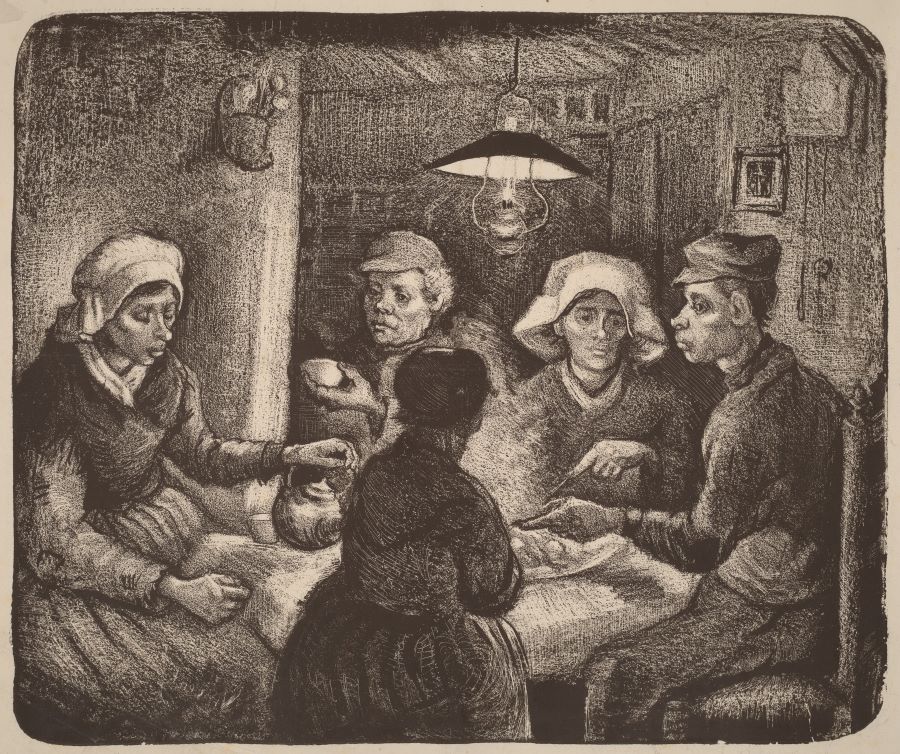
Vincent van Gogh, Potato Eaters, 1885
Crayon lithograph with scraping printed in dark brown on thin wove paper
Dimensions
image: 26.3 x 31.6 cm (10 3/8 x 12 7/16 in.)
sheet: 31.7 x 40.6 cm (12 1/2 x 16 in.)
National Gallery of Art, Washington DC
This image is in the public domain.
Van Gogh had hoped that the picture would gain him entry into the Parisian art scene.
But the picture did not appeal to the public. It was very dark and the human figures suffered from many drawing errors for Vincent’s goal to be achieved.
Theo wrote to Vincent that he finds the picture lacking intensity, especially in view of the domination of the impressionist’s colours in Paris. The harshest critic of the painting was van Rappard, who pointed out that the human figures had many errors. For example, the man on the right side has no knee, while his arm is short.
Five years later, in 1890, Vincent was interned in a psychiatric asylum in Saint Remy, near Arles in Provence, France.
He decided to rework the potato eaters and started sketching with pencil on paper human figures around a table. The improvement in rendering the human body is visible.
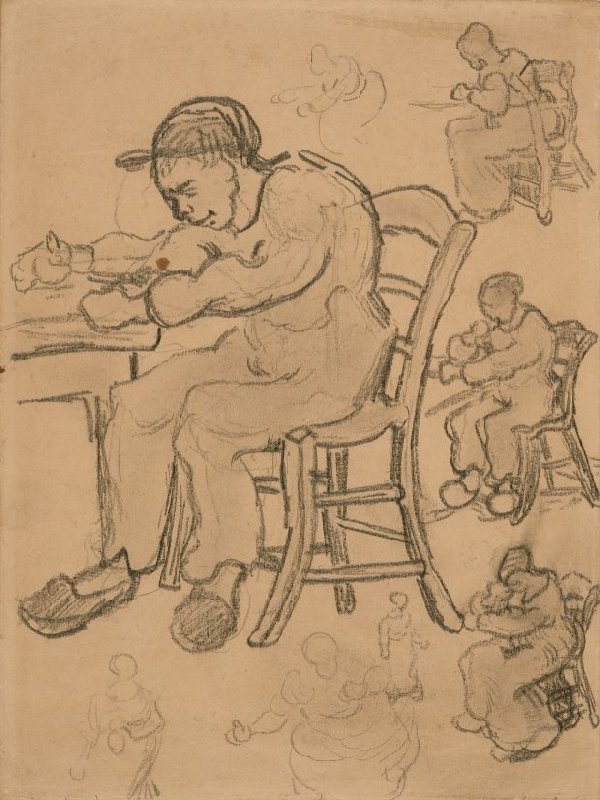
Vincent van Gogh, 1890
Sketches of Figures Seated at a Table
Vincent van Gogh (1853 – 1890), Saint-Rémy-de-Provence, March-April 1890
pencil on paper, 31.9 cm x 23.9 cm
Credits: Van Gogh Museum, Amsterdam (Vincent van Gogh Foundation)
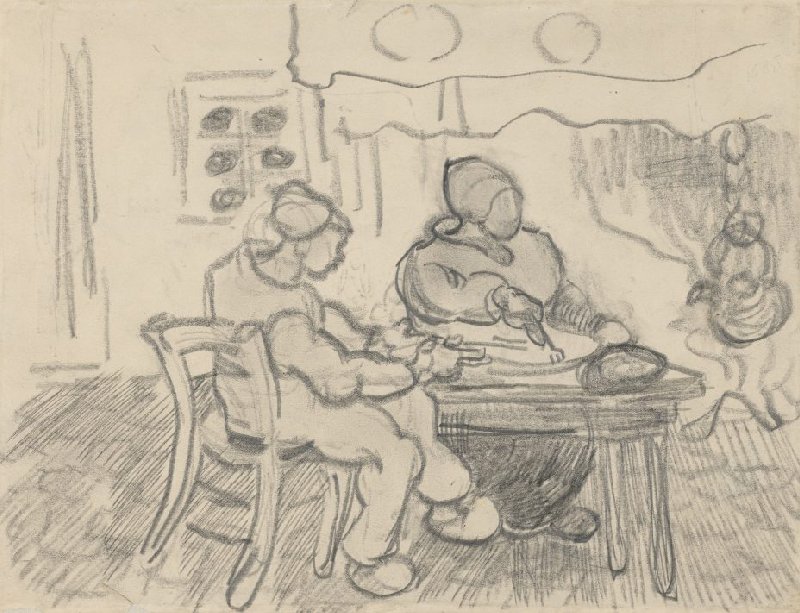
Interior with Two Figures Eating
Vincent van Gogh (1853 – 1890), Saint-Rémy-de-Provence, March-April 1890
pencil on paper, 24.4 cm x 32.0 cm
Credits (obliged to state): Van Gogh Museum, Amsterdam (Vincent van Gogh Foundation)
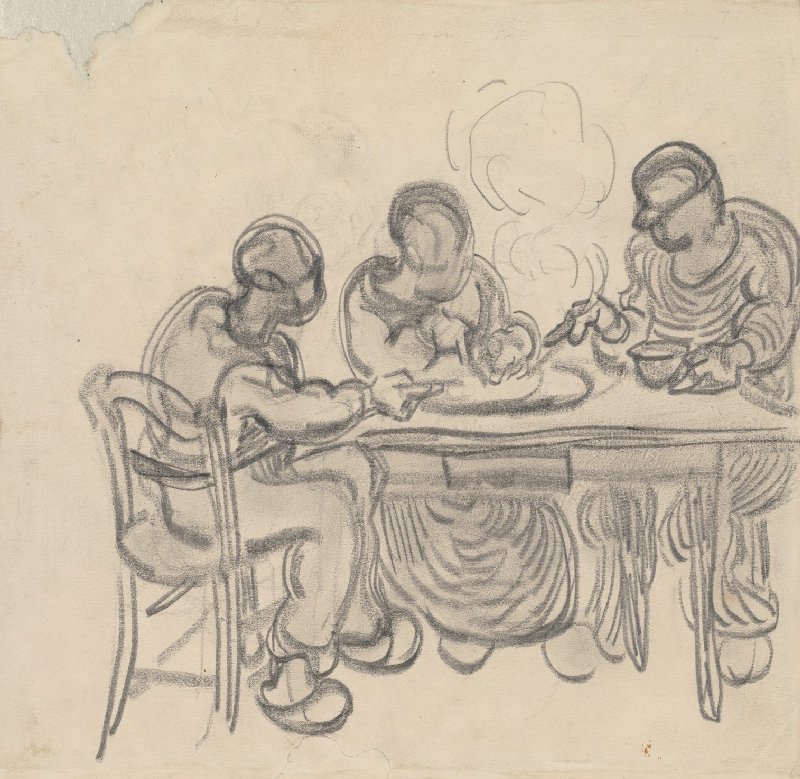
Three Figures Eating
Vincent van Gogh (1853 – 1890), Saint-Rémy-de-Provence, March-April 1890
pencil on paper, 24.4 cm x 25.3 cm
Credits: Van Gogh Museum, Amsterdam (Vincent van Gogh Foundation)
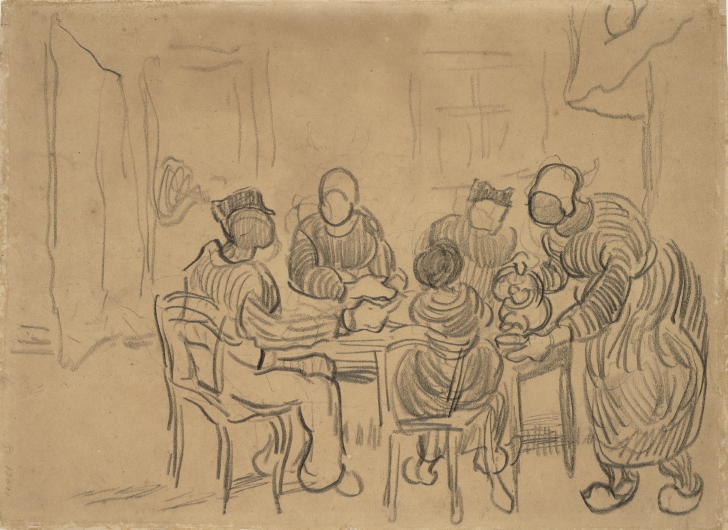
Vincent van Gogh, ‘Interior with Five Figures Around a Table’, March-April 1890,
pencil on paper, 23.2 x 32 cm,
Van Gogh Museum, Amsterdam (Vincent van Gogh Foundation)
However, van Gogh did not manage to paint a new version of the potato eaters. In July 1890 he committed suicide in a suburb of Paris, Auvers-sur-Oise
 Gastrolvios