The Italian painter Michelangelo Merisi or Amerighi da Caravaggio was born in 1571 and died in 1610.
At the beginning of his career during his internship he has influenced by the style of Lombardy, which emphasized simplicity and the careful depiction of reality, being closer to German naturalism rather than Rome’s magnificent mannerism.
In his short life he painted masterpieces on many subjects. In some of them there is violence, blood, pain, death, suffering. The subject I selected for this post has none of these. It is fruits, be it the primary or secondary subject, be it in a basket or not.
The picture is in the Public domain
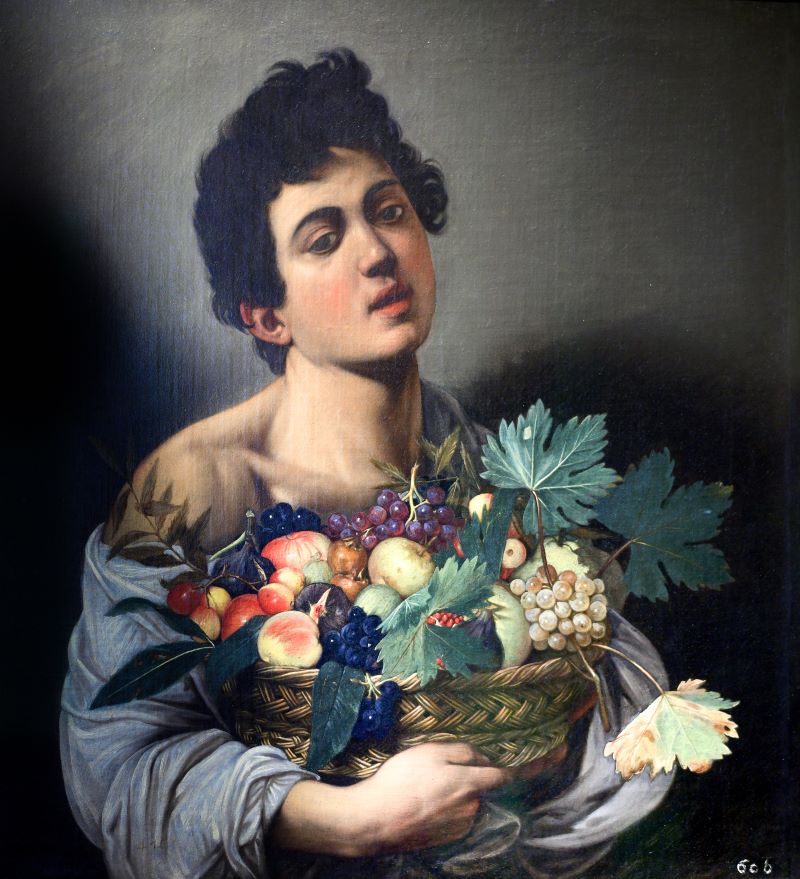
Caravaggio, Boy with a Basket of Fruit (Fanciullo con canestro di frutta), 1593-1595.
Oil on canvas
Dimensions 70 cm × 67 cm (28 in × 26 in)
Galleria Borghese, Rome, Italy
This is a picture with two subjects.
A boy and a fruit basket. It is a real to life painting loaded with sensuality expressed by the naked right shoulder, the tilting of the boy’s neck and the way his right hand folds around the bottom of the basket. It is an invitation to earthy pleasures, symbolized by the fruits and the naked flesh. The grey – black background is a reminder of death and decay that is inevitable. We therefore better enjoy life while we can, be it fruits, or the pleasures of carnal entanglement, or both.
Below I quote extensively from the Gallery’s website.
Start Quote
Boy with a Basket of Fruit dates from the beginning of the artistic career of Caravaggio (Michelangelo Merisi), who, having come to Rome from Milan in the last decade of the Cinquecento, worked briefly for the Cavalier d’Arpino and his brother, Bernardino Cesari. The painting dates to his early period as a painter of still lifes; datable to 1593/95.
Description
The painting dates to when Caravaggio, who arrived in Rome from Milan, was making his career in the Roman art world. The model was his friend, the Sicilian painter Mario Minniti, at about 16 years old. Primarily, the artwork belonged to Giuseppe Cesari, the Cavaliere d’Arpino, seized by Cardinal Scipione Borghese in 1607.
Many historians refer to other works of the same period featuring Minniti as a model, such as The Fortune Teller and the Cardsharps from 1594. In addition, the Cardsharps brought Caravaggio to the attention of his first significant patron, Cardinal Francesco Maria del Monte.
Analysis
Boy with a Basket of Fruit painting is an oil on canvas with 70 х 67 cm. There is no coincidence that this canvas belonged to the Cavalier d’Arpino, from whom it was confiscated, together with other artworks in 1607. It was in the Cavalier’s studio that, according to Giovanni Pietro Bellori, Caravaggio learned “to paint flowers and fruit so well imitated that everybody came to learn from him how to create the beauty that is so popular today.”
The painting was created during his early period as a painter of still lifes. It may be related to his famous Basket of Fruit in Pinacoteca Ambrosiana, Milan, executed in 1596. The fruit and leaves are illustrated in both paintings with the same irregularities and imperfections found in real-life and nature.
The painting expresses sensuality, marking similar canvases of the master of the early period: a handsome street boy took a beautiful pose, tilting his head slightly, lowering his shirt from one shoulder, and gently pressing his basket to himself. The artist skillfully depicted the velvety color of peaches, glossy apples, and dark spots on the fruits and dried leaves. The brightest fruits are apples, and the artist showed the rest of the fruits in neutral colors to make everything look harmonious. After all, if Caravaggio took a lot of bright colors, the viewer’s attention would be spent only on fruit, then one would have forgotten about the main character.
The artist paid great attention to colors and light. In this painting, it is immediately apparent that the light falls on the left side. After all, the brightest spots are the young man’s left cheek and shoulder. On the contrary, the shadows fall on the right side of the painting. The background of the artwork is the most common gray wall. The artist mainly depicted a guy in a room, not in nature, so the fruit does not merge with the natural environment.
Professor Jules Janick of the Department of Horticulture and Landscape Architecture at Purdue University, Indiana, has analyzed fruits from a horticulturist’s perspective:
‘The basket … contains a great many fruits, all in nearly perfect condition and including a bi-colored peach with a bright red blush; four clusters of grapes — two black, one red, and one “white;” a ripe pomegranate split open, disgorging its red seeds; four figs, two of them dead-ripe, black ones, both split and two light-colored; two medlars; three apples—two red, one blushed and the other striped, and one yellow with a russet basin and a scar; two branches with small pears, one of them with five yellow ones with a bright red cheek and the other, half-hidden, with small yellow, blushed fruits. There are also leaves showing various disorders: a prominent virescent grape leaf with fungal spots and another with a white insect egg mass resembling that of the oblique banded leaf roller (Choristoneura rosaceana), and peach leaves with various spots.’
End Quote
See also Galleria Borghese.
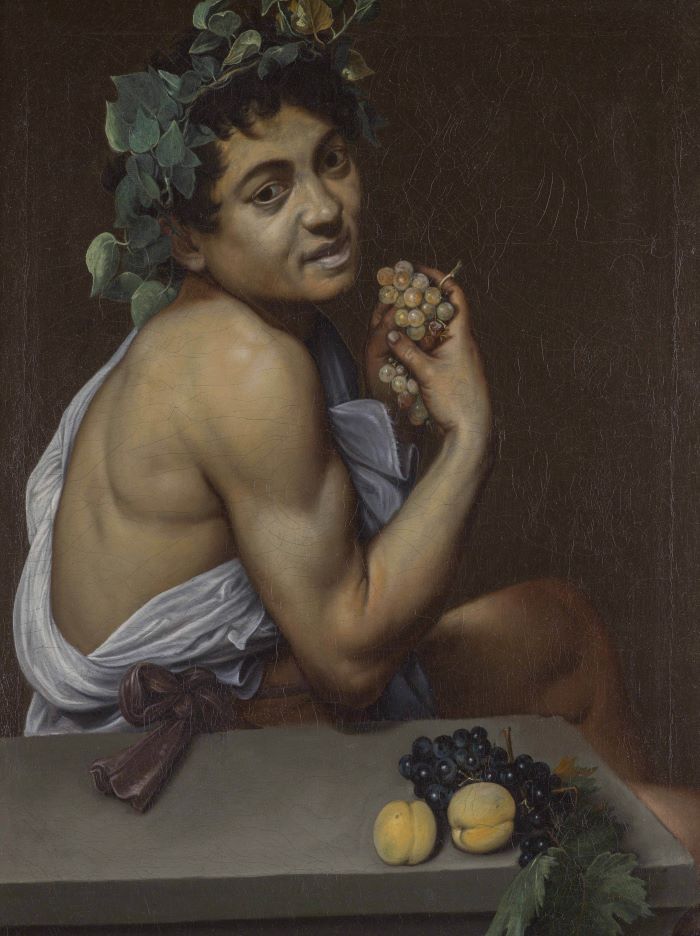
Caravaggio, Bacchino Malato (Self-portrait as Bacchus), 1595, oil painting on canvas
Dimensions: 67 x 53 cm
Galleria Borghese, Rome, Italy
Bacchus is the protagonist of the picture. Grapes and apricots are the secondary subject. The light is weak, like the health complexion of the sick Bacchus.
Below I quote from the Gallery’s website.
‘Like the Boy with a Basket of Fruit ( inv. 136 ), this canvas also comes from the group of works confiscated in 1607 from Giuseppe Cesari, known as the Cavalier d’Arpino, accused by Paul V’s tax authorities of illegal possession of firearms. In order to redeem himself, the painter was forced to cede his picture gallery to the Apostolic Chamber, which was donated shortly afterwards by the Pope to his nephew Scipione Borghese.
The painting portrays with extreme realism the figure of a young man with the typical attributes of Bacchus, god of wine and inebriation, who turns to the viewer in an atypical pose – three-quarter view – showing a lush bunch of white grapes in his hands , in clear contrast to his cerulean and unhealthy complexion.
Critics have identified the subject as a possible self-portrait of the artist, tracing the painting back to a documented event in the painter’s life, namely his hospitalization at the Consolazione Hospital in Rome due to unspecified circumstances. Hence the interpretation from which the title of the work originates: Self-portrait as Bacchus or more commonly the sick Bacchus.‘
The picture is in the Public domain.
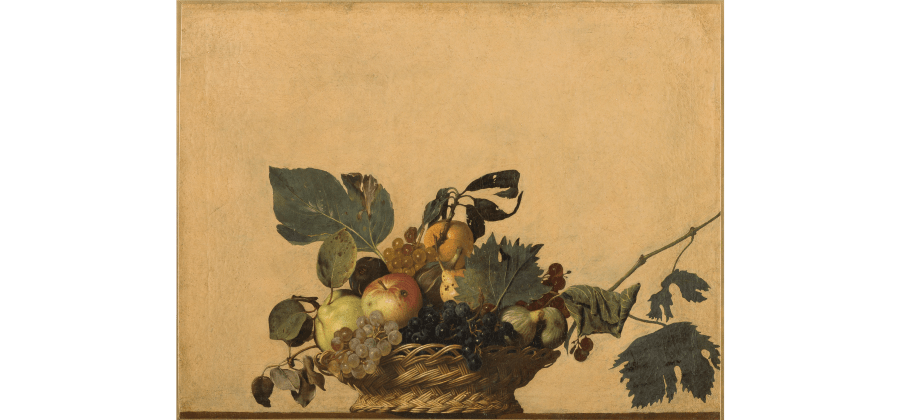
Basket of fruit, Michelangelo Merisi da Caravaggio, c. 1597 – 1600
Oil on canvas, 54,5 × 67,5 cm
Pinacoteca Ambrosiana, Milan, Italy
The fruit basket is the primary and only subject in this picture. The background of the picture is light ochre, the fruits are almost real.
Below I quote from the pinacoteca’s website.
‘This is probably the most famous painting in the collection of Cardinal Federico Borromeo, which formed the original nucleus of the Pinacoteca Ambrosiana. It is considered to be a sort of prototype of the “still life” genre. It shows a wicker basket brimming with fruit and leaves, rendered with great realism and attention to detail. This almost conflicts with the abstract neutral background of the painting and with the line of colour the basket itself is resting on, and from which it juts out. The founder of the Ambrosiana mentions this extraordinary painting many times in his writings and says he has searched in vain for a work that can bear comparison to it. But, he writes “for its incomparable beauty and excellence, it remained alone”. The painting has been interpreted in many different ways, some of which are religious: the extreme realism with which the fresh fruits are placed alongside those that are worm-eaten, and the leaves that gradually dry out and shrivel, give tangible form to the inexorable passing of time.’
The picture is in the Public domain
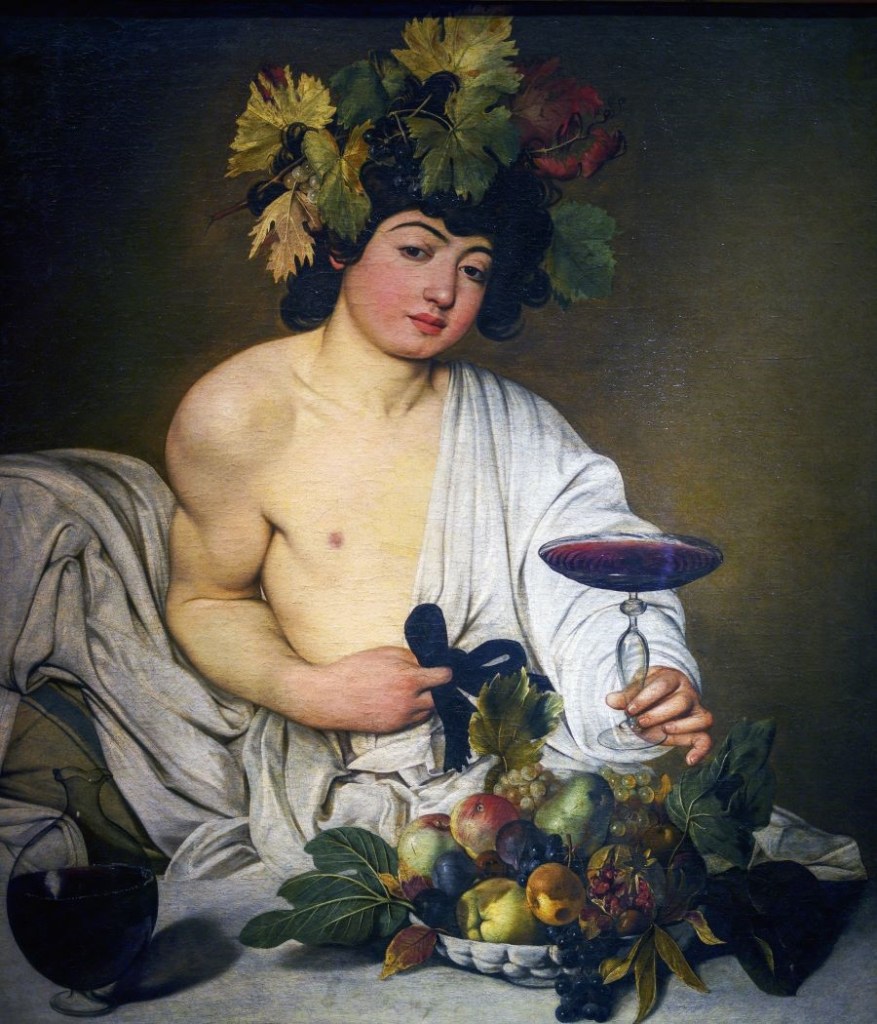
Caravaggio, Bacchus (Bacco) 1598, Oil on canvas
Size: 95 x 85 cm
Galleria Uffizi, Florence, Italy
Below I quote from the Galleria’s website.
This painting is part of the author’s early series of half-length portraits painted ‘in chiaro’, which includes works such as the ‘Fruttaiolo’ (Boy with a Basket of Fruit) from the Galleria Borghese in Rome, the ‘Fanciullo morso dal ramarro’ (Boy bitten by a Lizard) belonging to the Fondazione Longhi in Florence, and the ‘Canestro di frutta’ (Basket of Fruit) from the Pinacoteca Ambrosiana in Milan. In this work, Caravaggio, who in the first decade of the 17th century was the protagonist of a revolution in painting that started in Rome and spread all across Europe, displays a masterful naturalistic portrayal of still life. His depiction of the basket of fruit and of the cup of wine proffered by the god is surprising, as these elements were interpreted by some critics as a Horatian invitation to frugality, conviviality and friendship. The sculpted figure of Bacchus, who has a stunned expression due to his state of inebriation, reproduces some models of classical art, in particular the portraits of Antinous, and is instilled with a languid sensuality. In the painting, art critic Mina Gregori detected a certain vision of antiquity that celebrates the freedom of senses, as well as a reference to the Bacchic costumes and initiation rites practised in Rome. Discovered in the Uffizi’s storerooms in 1913 and attributed to Caravaggio by art historian Roberto Longhi, the masterpiece belongs to the painter’s early career in Rome, when he was under the patronage of Cardinal Francesco Maria del Monte. This painting, together with the Medusa (inv. 1890 no. 1351), was donated by Cardinal del Monte to Ferdinando I de’ Medici on the occasion of the wedding of his son Cosimo II in 1608.
 Gastrolvios