Most recent update: 15th August 2024
The French painter Eduard Manet (1832 – 1883) kickstarted the modern era of painting in 1863 with ‘Le ‘Déjeuner sur l’herbe’. The picture did not have the until then two dominant features of western painting: noble subjects and historical figures, and a three-dimensional perspective. Another ground breaking picture by Manet is ‘Olympia’, painted also in 1863. Both pictures are in the Musee d’ Orsay in Paris.
In addition to painting ground breaking pictures, from 1862 to 1878 Manet painted many still lifes with fruits and fish on a dinner table, and had called still life the ‘foundation of the painter’. He was inspired among others, by the picture of a brioche by Chardin.
In this post I share three oyster pictures painted by Manet.
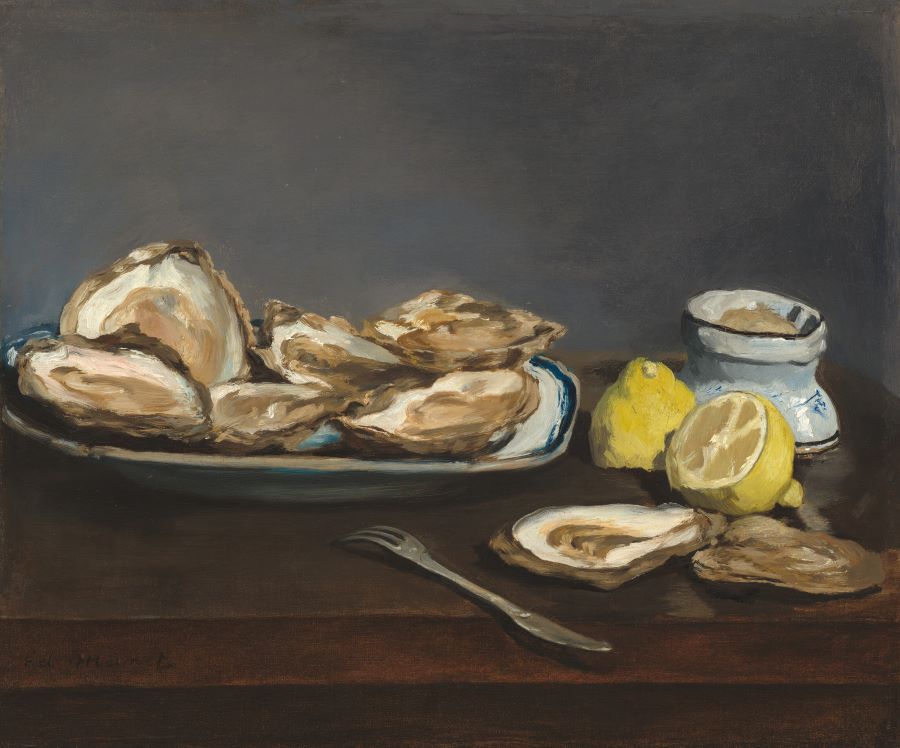
The picture is in the public domain.
Edouard Manet, Oysters, 1862, oil on canvas
Dimensions
overall: 39.2 x 46.8 cm (15 7/16 x 18 7/16 in.)
framed: 60 x 67.6 x 8.9 cm (23 5/8 x 26 5/8 x 3 1/2 in.)
National Gallery of Art, Washington DC
A plate of oysters, a halved lemon, an oyster fork and shells, and a dish of salt are arranged on a wooden tabletop in front of a grey wall in this horizontal still life painting. This is the first sill life picture with food that Manet painted, and he dedicated it to this wife.
The front edge of the table seems close to us, and the objects span the width of this composition. Six oysters are crowded on the oval plate, which is white and edged with royal blue. The narrow tines of the oyster fork are angled toward the plate as the handle, which is shaped like the blade of a butter knife, angles to our right and seems to jut into our space. The two empty shells are next to the knife in front of the lemon, which has been cut in half through its girth. One cut edge faces our left and the other half rests with its cut edge down on the table. The bowl with salt mounded within is about the same size as the lemon and has a border of brown at the top and near the foot. The entire painting is loosely painted with visible brushstrokes, and some vague lines on the side of the bowl suggest a Japanese or Chinese character.
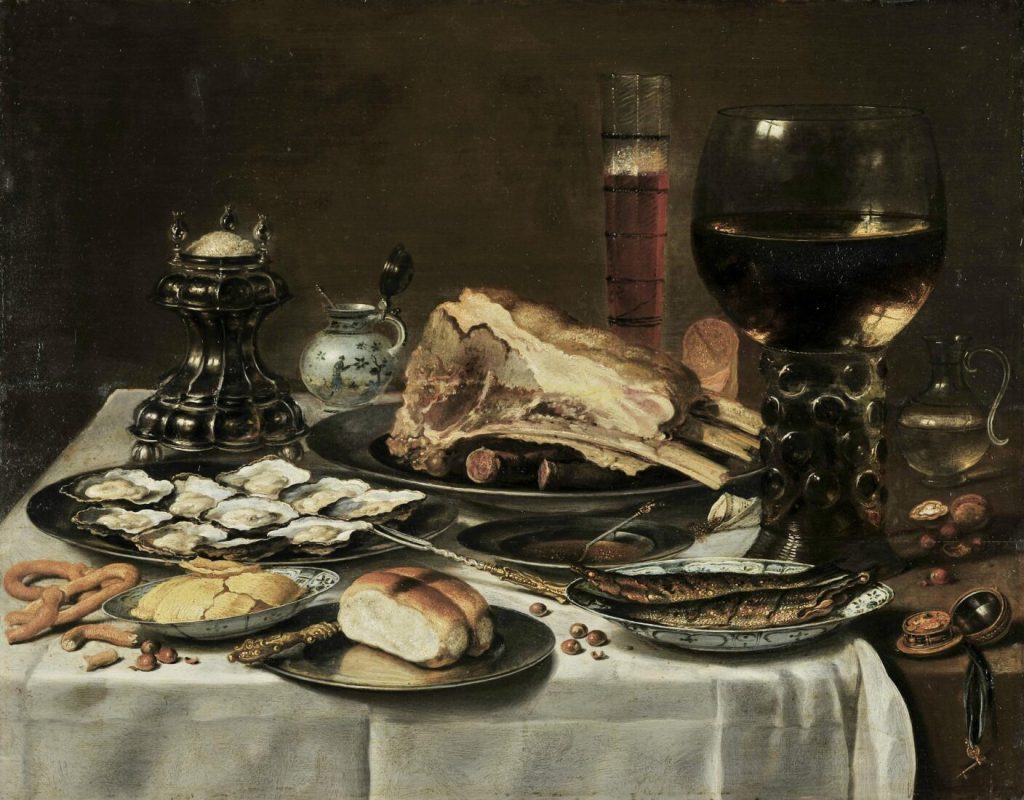
It is interesting to compare Manet’s picture to an earlier painting by the Heda Willem Claesz (1594 – c.1680), Still Life with Meet, Oysters, Smoked Herring, Glass of Wine and Glass of Beer, now in the National Gallery of Greece in Athens. Although in theory still life paintings were to demonstrate the futility of life, this offers food and drink in abundance, almost exonerating the luxurious aspects of life. Viewed in this context, Manet’s oysters are ascetic.
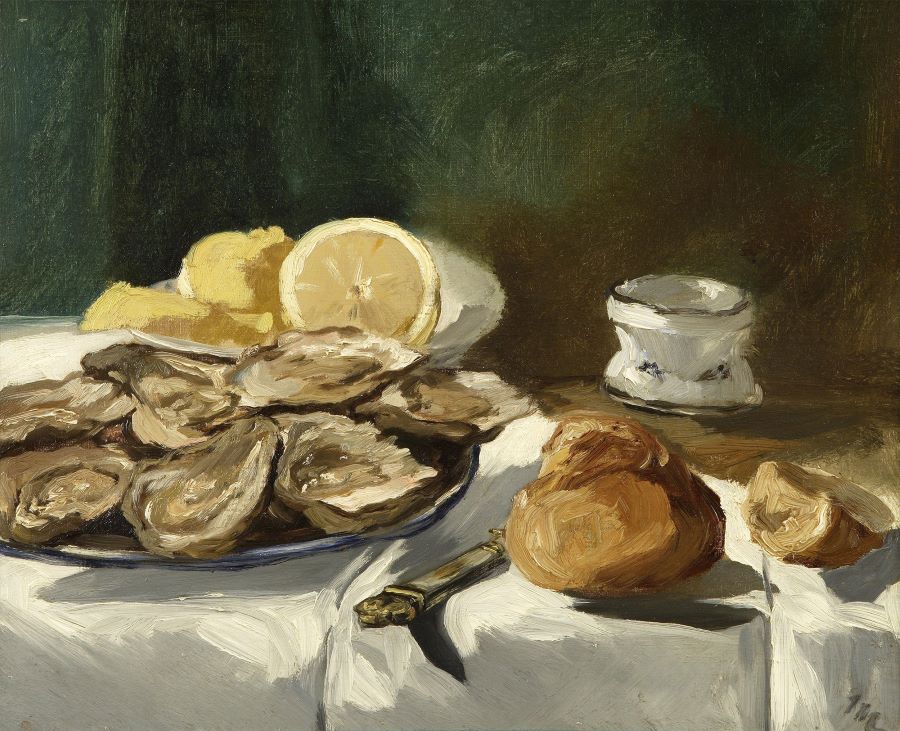
In 1876 Manet painted a still life with brioche, oysters and lemon. Compared to the 1862 picture, the 1872 painting has a tablecloth and a brioche. The brush stroke is coarser, the painter apparently used a wider brush. The knife is hanging over the table edge, but in the 1872 picture is pointing to the right, rather than on the left. Overall, the 1872 picture is less detailed, harsher to the eye.
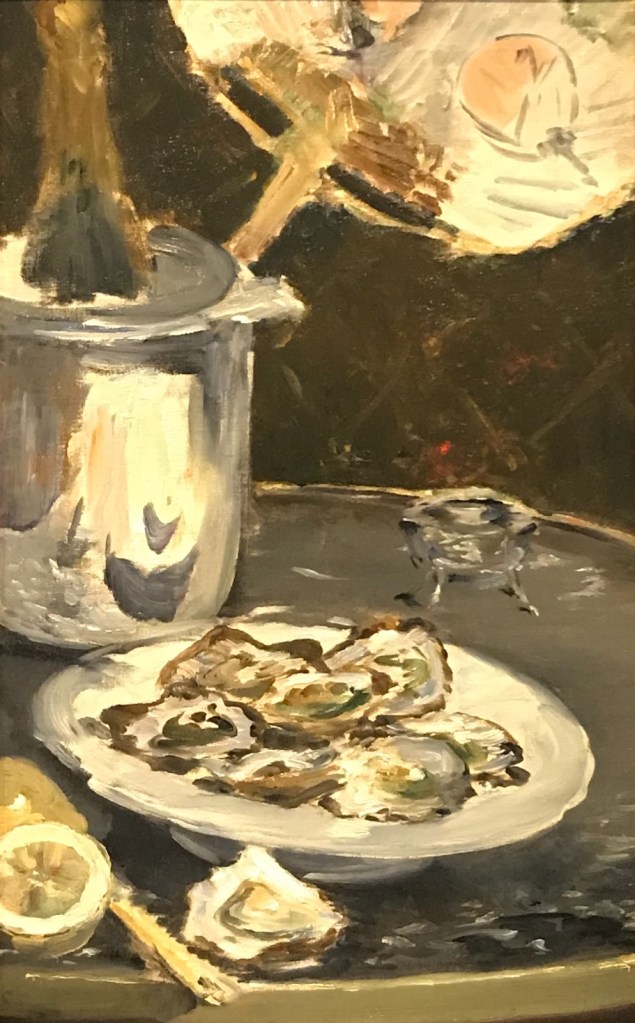
Édouard Manet, Still Life with Oysters and Champagne, 1876-78
This exuberant still life features a plate of oysters, a bottle of champagne, and their various accessories. The subject (especially the Japanese fan) and daringly cropped composition, and fluid paint handling signal Manet’s fashionable modernity. The painter abandons detail as he grows older but loses none of his enthusiasm for still life.
 Gastrolvios