
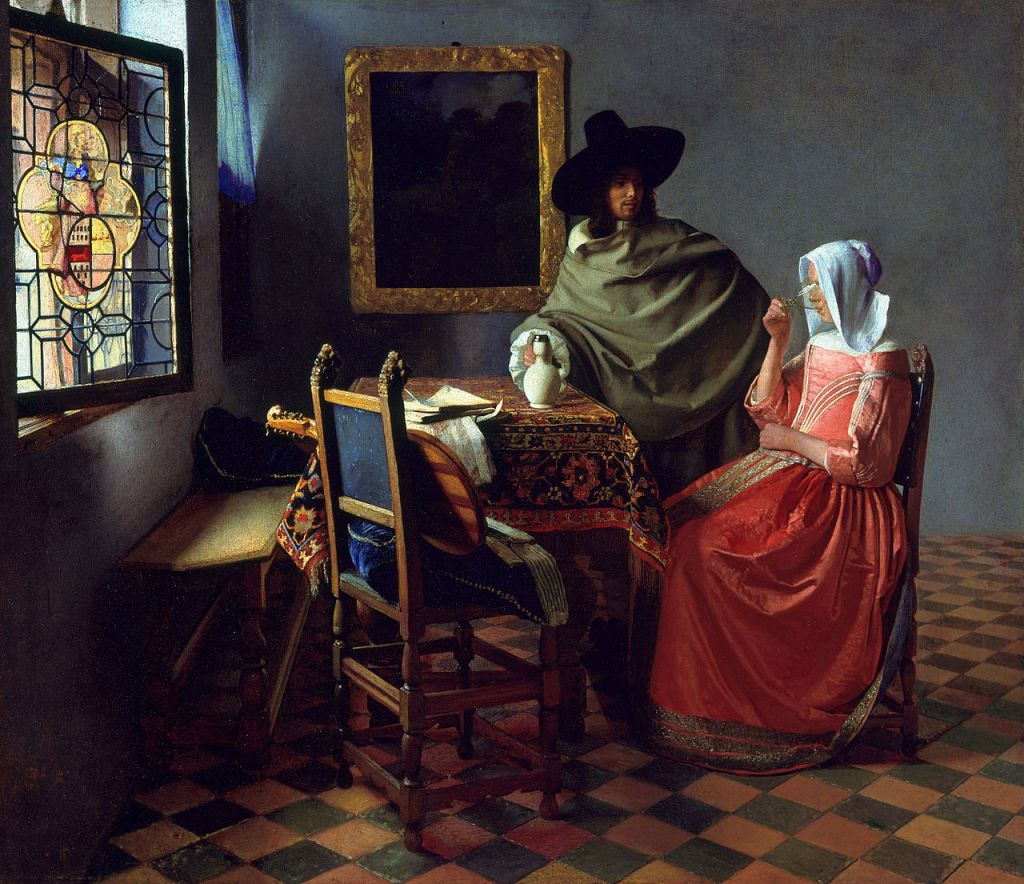
The Glass of Wine (also The Glass of Wine or Lady and Gentleman Drinking Wine)
Credit: Staatliche Museen zu Berlin, Gemäldegalerie / Christoph Schmidt
The image is in the public domain and can be freely reused. The image was taken directly from the object and checked for authenticity/correspondence with the depicted work. We therefore ask you to credit the institution where the object is housed (Collection, National Museums in Berlin).
Artist: Johannes Vermeer
Year: 1658/60
Medium: canvas, paint
Dimensions: 67.7 cm (26.7 in) × 79.6 cm (31.3 in)
Location: Gemäldegalerie, Berlin
Source: Jan Kelch, Katja Kleinert 200 Masterpieces of European Painting – Gemäldegalerie Berlin, 2019
In the reflected cool daylight, which filters in from the left, primarily through the front of the two windows, a young woman sits at a table drinking wine. She has turned her glass, almost full, towards her face, as if trying to escape the expectant gaze of the elegant gentleman who stands ready to refill her glass, wine jug in hand but without his own glass. A romantic encounter of dubious character is beginning. Yet, there is nothing crude or overtly erotic about the scene.A cittern and sheet music had been placed on the chair and table, possibly indicating that the couple played music together. Vermeer transformed a common theme among Dutch genre painters. He may have been inspired by his fellow painter Gerard ter Borch, who also depicted a cavalier, hand on his bottle, watching a lady drink. However, while the gentleman in ter Borch’s painting has his arm around his lady’s shoulder, Vermeer provides no explicit indication of the nature of his couple’s relationship. Whether the drinking will lead to debauchery remains uncertain.
On the left side, a slightly open window is depicted with a colored coat of arms, on which a female figure can be seen holding intertwined ribbons. A corresponding figure can be found among the emblems published by G. Rollenhagen in 1617. There, the ribbons are shown as a bridle, alongside the set square, an attribute of “temperance.” The accompanying text of the emblem reads: “Mens Servare Modum, rebus sufflata secundis, / Nescit, et affectus fraena tenere sui.” (The heart, when struck by a breath of happiness, does not know how to keep measure or rein in its emotions.) This reference refers not only to the drinking of wine, but to the relationship between the depicted figures and their foreseeable lack of restraint. It is a warning to “keep the right measure.” Vermeer used this emblem again in a second painting in the same context. In the painting “Girl with Wine Glass” (Herzog Anton Ulrich Museum, Braunschweig), however, the gentleman’s suggestive advances are highlighted far more explicitly.
The close-up view of objects is abandoned for the first time in the Berlin painting. Vermeer allows the viewer to step back by setting them off with the empty chair at the table. The resulting distance broadens the perspective. The interior is no longer perceived as part of the framed scene; rather, the figures are now part of the interior. Innovations of this kind point to the influence of the early masterpieces of Pieter de Hooch, Vermeer’s Delft painter colleague, who was three years older. De Hooch’s interior depictions from around 1658 are primarily conceived and designed from the perspective of the interior’s architecture. However, what Vermeer was able to achieve with an interior of de Hooch’s type is clearly demonstrated by the Berlin painting, which impresses with its rigorously calculated composition and also with the illusionism of the painting technique, which is maintained even in the differentiation of surface qualities without being exhausted by this purely objective determination. In the omnipresent light, things acquire the appearance of a higher quality.
Illuminated by cool daylight entering through two windows, mainly through the front one, a young woman sits at a table and drinks wine. She presses the glass to her face to empty it completely, as if she wanted to avoid the expectant look of the elegant cavalier, who stands with the jug in his hand but no glass of his own, ready to pour more wine. An amorous relationship of a dubious nature has been initiated. Nevertheless, the events are not imbued with anything crude or superficially erotic.On the chair and table, a cittern and sheets of music have been set aside, a possible reference to the couple having made music together. Here, Vermeer transforms a common subject of Dutch genre painters. He may have been inspired by his colleague Gerard Ter Borch, who also painted the motif of a cavaliers who watches a lady drinking, his hand on the bottle. Whereas the gentleman in Ter Borch’s painting has laid his arm around the lady’s shoulder, Vermeer provides no explicit clue to the nature of the couple’s relationship. It remains unclear whether the enjoyment of alcohol will end in debauchery.
On the left, on a slightly open window with a colorful coat of arms, the figure of a woman with interlacing straps in her hand can be discerned. A figure of this kind is among the emblems that G. Rollenhagen published in 1617. Here the straps prove to be harnesses, which alongside the set square are an attribute of “La Temperantia” (temperance). The text that accompanies the emblem is “Mens Servare Modum, rebus sufflata secundis, / Nescit, et affectus fraena tenere sui.” (The heart knows not how to maintain moderation and rein in the feelings when it is touched by a breath of fortune.) This statement relates not only to drinking the wine, but in general to the relationship between the two persons depicted and their foreseeable lack of restraint. It is a warning to “maintain moderation”. In a second work, Vermeer applied a depiction of this emblem to the same context. In the painting Girl with a Wine Glass (Braunschweig, Herzog Anton Ulrich-Museum) the indecent advances of the gentleman are emphasized much more explicitly, however.In this work in Berlin, the close-up view is abandoned for the first time. Vermeer makes viewers stand back, separating them by means of the unoccupied chair at the table. The distance thus gained widens the angle of view.
The interior is no longer perceived as part of an excerpt of figures, but rather the figures are now part of this excerpt from the interior. Innovations of this kind point to the influence of the first masterpieces by Pieter de Hooch, a painter colleague of Vermeer from Delft who was three years older. De Hooch’s interiors of around 1658 are primarily conceived and designed starting from the interior architecture.
What Vermeer, however, was able to achieve with an interior of the type painted by de Hooch is demonstrated particularly by this painting. The Berlin work is impressive in its austerely calculated structure and also in the illusionistic manner of painting, which is retained evenin the differentiation of surface characteristics but without being reduced to this purely item-related purpose. In the ubiquitous light, objects take on the appearance of possessing a higher quality.
Jan Kelch, Katja Kleinert | 200 Masterpieces of European Painting – Gemäldegalerie Berlin, 2019
 Gastrolvios