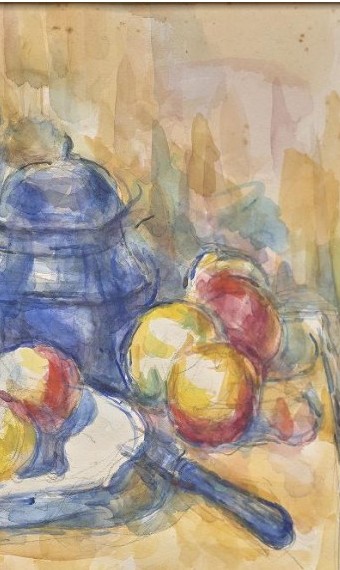
Today I share four Cezanne watercolors. They are beautiful and inspiring.
The world is beautiful, but only if we have the eyes to wiew its beauty.
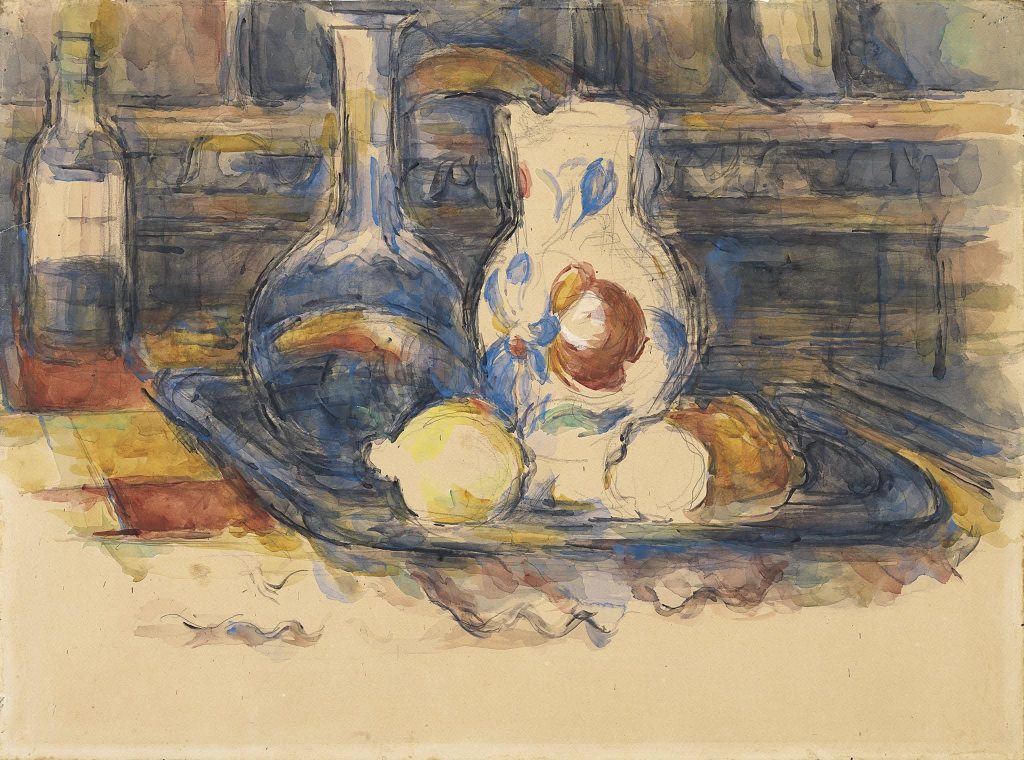
Paul Cézanne
Bottle, Carafe, Jug and Lemons
1902 – 1906
Watercolor on Paper. 44.5 x 60 cm
Museo Nacional Thyssen-Bornemisza, Madrid
Inv. no. 489 (1979.18)
What follows is sourced from the website of Museo Nacional Thyssen-Bornemisza, Madrid
Paul Cézanne spent the last years of his life in retirement in his native Provence, painting the scenery and country folk around Aix-en-Provence, as well as executing numerous still lifes in the solitude of his new studio on the hillside known as Les Lauves. The artist had long ceased to regard painting merely as a means of representing the world and viewed it as an analytical process of exploring the structures of reality, for which nothing was more appropriate than still life.
Although Cézanne’s interest in depicting inanimate objects is evident in the still lifes painted during his youthful years, which are still tinged with a certain amount of Romanticism, it was in the more experimental compositions of his mature years that he achieved greater mastery and confidence. Bottle, Carafe, Jug and Lemons is among these paintings produced in the last years of his life, in which, as the British critic Roger Fry stated, “he achieved in still-life the expression of the most exalted feelings and the deepest intuitions of his nature.” On a tray lying on a table covered with a simple checked tablecloth is a small group of household containers of different shapes and sizes and two lemons (or possibly a piece of bread and a lemon, as Terence Maloon points out). The flowerpatterned earthenware jug in the centre — most likely crafted at one of the pottery works around Aix — stands out as a motif in its own right. There is a certain divergence between the diagonal perspective of the tray and slanting lines of the tablecloth and the play of horizontals and verticals in the spatial plane of the background wall. This creates a network of lines running in opposite directions and, at the same time, an effect of spatial unity, which heightens the emphasis on the two-dimensionality of the picture plane.
In 1904 Cézanne advised the young painter Émile Bernard to depict “nature by means of the cylinder, the sphere, the cone, everything brought into proper perspective, ” making clear that geometric shapes were essential instruments for capturing real-life experience. In accordance with this belief, Cézanne built this balanced composition from a number of volumes with well defined contours reduced to their basic geometric shapes. In addition, like the Impressionists, he replaced contrasts of light and darkness with contrasts of cold and warm colours.
This still-life painting is furthermore a significant example of the skill the artist attained in watercolour, a difficult medium. Whereas the density of the constructive brushstrokes is similar to that found in Cézanne’s oil paintings, the transparency of the paint, which leaves the paper visible in certain areas, not only reveals the internal structure of the composition but allows him to accomplish visual effects with masterful harmony. The spatial arrangement and radical language of the watercolours dating from Cézanne’s final period constitute, in Fry’s words, a kind of abstract system of plastic rhythms, and foreshadow the Cubist still-lifes of Picasso and Braque.
Paloma Alarcó
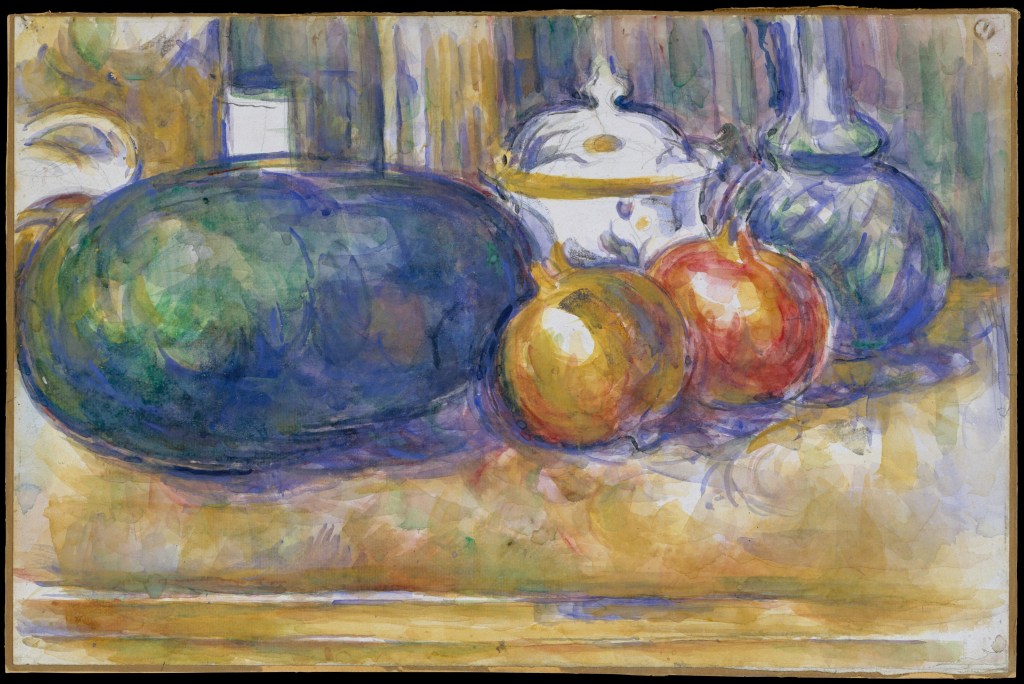
Title: Still-Life with a Watermelon and Pomegranates
Artist: Paul Cézanne (French, Aix-en-Provence 1839–1906 Aix-en-Provence)
Date: 1900–1906
Medium: Watercolor over graphite on laid paper
Dimensions: sheet: 12 3/8 x 19 3/16 in. (31.4 x 48.8 cm)
Classification: Drawings
Credit Line: The Walter H. and Leonore Annenberg Collection, Gift of Walter H. and Leonore Annenberg, 2001, Bequest of Walter H. Annenberg, 2002
Object Number: 2001.202.1
The Metropolitan Museum, New York, USA
The following is sourced from the website of the Met Museum in NY.
Of the twenty or so watercolor still lifes Cézanne produced during his final years, this work is among the most fully realized. With fluid strokes of saturated color, the artist calls attention to his skills of both observation—his attention to the reflections among objects is rarely as apparent—and creation. The rounded objects clustered together, including a hulking watermelon, two pomegranates, a bulbous glass vase or carafe, and a sugar bowl conjured from the reserved white of the paper, have both a volumetric quality and an intangibility. Marks in the corners left by thumbtacks, especially evident at upper right, are a reminder of the process of making this luminous and intensely colored sheet.
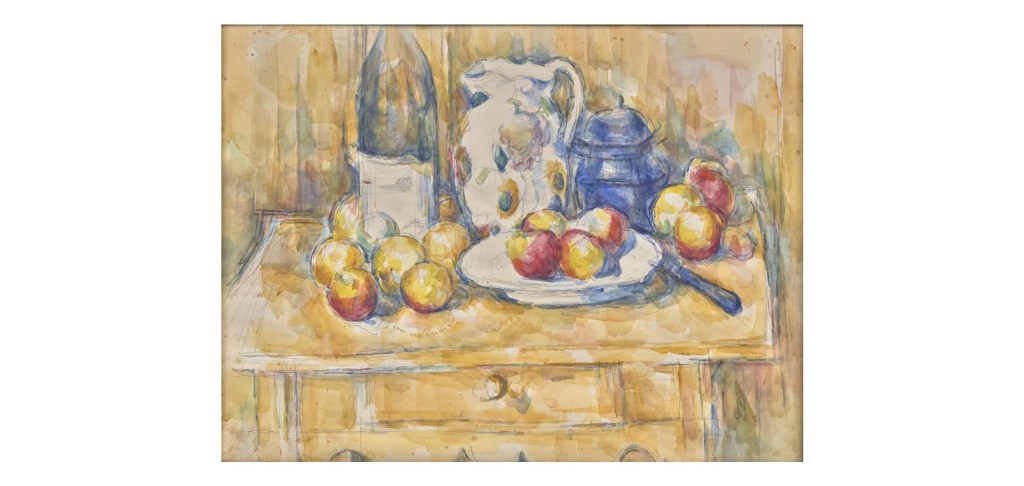
Still Life with Apples on a Sideboard
Paul Cézanne
Date: 1900–1906
Material and Technique: Watercolor over pencil on paper
Dimensions: Sheet dimensions: 19 1/8 × 24 7/8 in. (48.58 × 63.18 cm) Framed dimensions: 35 1/4 x 43 in. (89.53 x 109.22 cm)
Object Number: 1985.R.12
Credit Line: Dallas Museum of Art, The Wendy and Emery Reves Collection
Copyright: Image courtesy Dallas Museum of Art
What follows is sourced from the website of the Dallas Museum of Art.
The watercolor medium arrived rather late in France. After a glowing history in British 18th- and early 19th-century art, it crossed the Channel in the work of a bilingual English artist, Richard Bonnington, and his friends the French artists Théodore Géricault and Eugène Delacroix. Although the French artists made distinguished contributions to the medium, watercolor did not in fact become central to French painting until the 1870s, when the impressionists practiced it fervently. The Reves collection is particularly rich in watercolors, but its crown jewel in the medium is this great Cézanne still life. Although one could have a full and complete discussion of the careers of Manet, Monet, Pissarro, Seurat, and Gauguin without ever mentioning watercolor, it would be impossible to do so for Cézanne. The watercolor medium was central to his technique as an artist, and as his career progressed, his oil technique increasingly resembled that of his watercolors. Indeed, his reliance on the primed canvas as a positive element in his late oil paintings would have been inconceivable without a knowledge of watercolor technique. This late watercolor is among the very finest of Cézanne’s career. Along with a small group of equally large and complex sheets scattered in major collections in the United States, Switzerland, France, and Britain, this watercolor is the apogee of his art. “Impressionist Paintings, Drawings, and Sculpture from the Wendy and Emery Reves Collection,” page 131
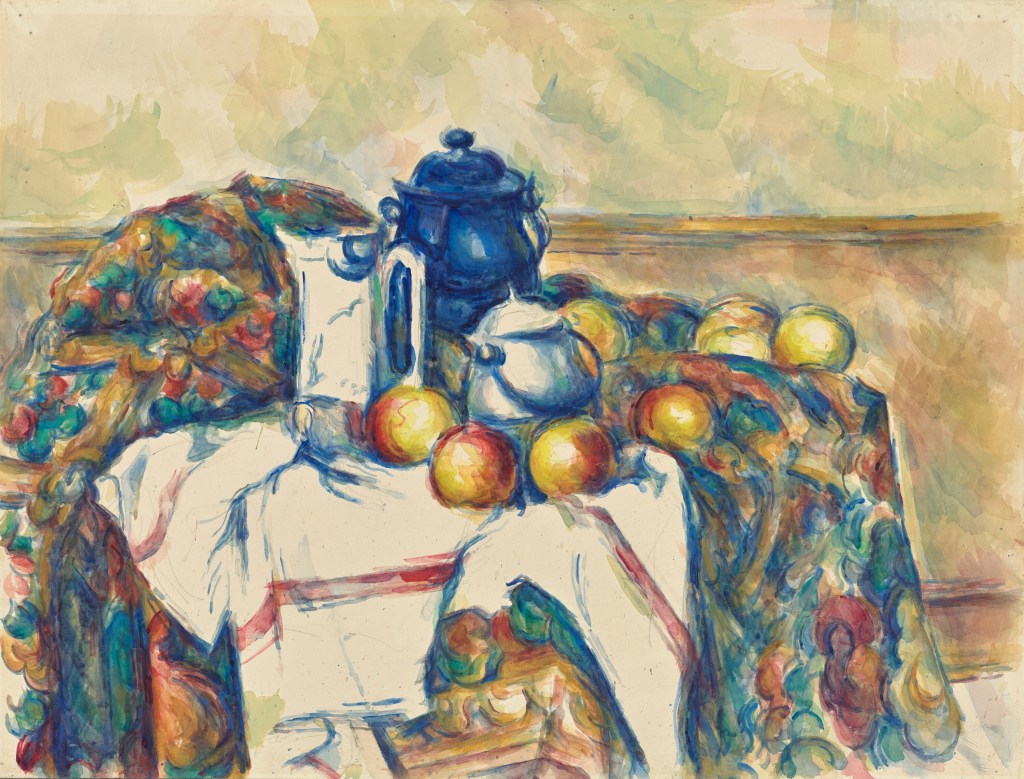
Paul Cézanne (French, 1839 – 1906)
Still Life with Blue Pot, about 1900–1906
Watercolor over graphite
Unframed: 48.1 × 63.2 cm (18 15/16 × 24 7/8 in.), Framed [Outer Dim]: 86.4 × 101.6 × 5.7 cm (34 × 40 × 2 1/4 in.)
The J. Paul Getty Museum, Los Angeles, 83.GC.221
What follows is sourced from the website of the J. Paul Getty Museum, Los Angeles.
The still life was a principal theme throughout Paul Cézanne’s artistic career. Using a repertoire of everyday objects such as fruit, jugs, bottles, and plates, he experimented with relationships of form, color, and pattern. Although the groupings seem casual, Cézanne is known to have taken great care with the arrangement, sometimes spending hours positioning the objects.
In this brightly colored watercolor, Cézanne’s monumental conception of form is evident: the jug, the two pots, one white, one blue, and the seven apples assume a physical presence beyond normal perception of their existence. Using small patches of color laid next to one another, Cézanne evoked the plasticity of substance, building form rather like bricks build structures. His fresh and vigorous brushstrokes are visible against the background wall as areas of greens and blues are juxtaposed. The apples are described with red arcs around the perimeter, then yellow brushstrokes next to the red; the empty middle suggests light reflecting off the surface. Curving brushstrokes of brown, green, and blue that seem to blend with the bottom half of the wall actually compose the tablecloth.
The following is a post by Christopher Lloyd in the the website of the J. Paul Getty Museum, Los Angeles. The text of this post © Christopher Lloyd. All rights reserved.
Paul Cézanne changed the course of European art forever.
He altered both the way we look at the world and the way we record it.
The evidence for this lies not just in his paintings, but also in his works on paper, and particularly the watercolors. From the start of his career Cézanne was a compulsive draftsman, filling numerous sketchbooks with studies made mainly in pencil but sometimes in conjunction with watercolor. These drawings reveal the private side of a complicated artist totally dedicated to his vocation.
Slowly, during the 1880s, watercolor became Cézanne’s preferred medium. He used it to pursue motifs—landscape, bathing scenes, portraits, still lifes—in parallel with his paintings. Only toward the end of his life, when his reputation began to be established among fellow artists, collectors, and dealers, did he make watercolors as independent works of art. These works reveal unusual powers of visual analysis and sensitivity of touch, as well as a mastery of technique that has never been surpassed.
Cézanne’s numerous watercolors of Mont Sainte-Victoire close to Aix-en-Provence show his allegiance to the landscape of his birthplace in the south of France, and those of male and female bathers demonstrate his adherence to the classical tradition. But it is in the still lifes that his true essence is revealed. Those dating from his final years were executed at several sittings in his studio at Les Lauves just on the outskirts of Aix-en-Provence, where he kept a limited selection of props just for the purpose.
Still Life with Blue Pot, in the Getty Museum’s collection, is one of the finest examples of Cézanne’s more elaborate, almost baroque, compositions rendered with a complete mastery of the medium. The steep, somewhat oblique, viewpoint with the table seen slightly from above, combined with the close-up effect of the items on display, is at first disorienting. Arranged precariously, the objects on the table often teeter uncertainly as though they might roll off at any moment. The overall treatment is almost eccentric: objects are distributed arbitrarily, and textures are depicted daringly in watercolor, a more liquid, diaphanous medium than thick oil paint. Given such a level of skill, it is not surprising to discover that Cézanne painted more still lifes in watercolor than in oil.
The miracle of these late still lifes by Cézanne is the way in which the personal becomes universal. The spatial disjunctions, the interplay between lines, the oscillation between forms dependent on light, the jostling of the colors and the reification (almost deification) of mundane objects create an image of almost transcendental significance.
One of his early admirers, the poet Rainer Maria Rilke, wrote that Cézanne aimed to discover “the inexhaustible nature within by seriously and conscientiously studying her manifold presence on the outside.” Cézanne’s art, therefore, was essentially an analytical exercise conducted for the purpose of comprehending and representing the world as he saw it. He searched for the most convincing and honest method of recording his sensations before nature, but at the same time he was conscious of the struggle involved in this process, and ultimately felt himself to be a failure.
Essentially, Cézanne raised more problems than he personally could solve. But it is his identification of those problems and his determination to overcome them that accounts for the veneration in which he is still held today.
 Gastrolvios